 Chinese Surname Guide
100 Chinese Surnames: Character Facts and Pinyin in Baijiaxing Order
Quick Answer: The list below contains the first 100 surnames in the traditional Baijiaxing sequence, from Zhao (赵) to Yin (尹). The numbers mark positions in a teaching text, not modern population ranks. Each entry gives a modern simplified character and a Mandarin reading; neither spelling nor list position proves a family connection.
Which list of 100 Chinese surnames is this?
There are two different requests hiding in that search: a list of the most common surnames today, and a list from the classic called Hundred Family Surnames. This page answers the second. It does not attach present-day population figures to an old literary order.
Taiwan's National Academy for Educational Research entry on Baijiaxing describes it as a surname-based educational primer with uncertain authorship. Its account connects the opening order with historical circumstances, not a census. The full text also contains considerably more than one hundred names. Treat “Hundred” as part of the work's title, not the size of China's surname vocabulary.
For the broader context, the Hundred Family Surnames overview introduces the text. The table here supplies the missing bounded list rather than another historical overview.
Quick Facts
- List scope
- First100 classic entries, Zhao through Yin
- Number meaning
- Text position, not population rank
- Writing form
- Modern simplified characters
- Pronunciation scope
- Mandarin reference readings; Le/Yue both noted
- Genealogy limit
- Character matches do not establish descent
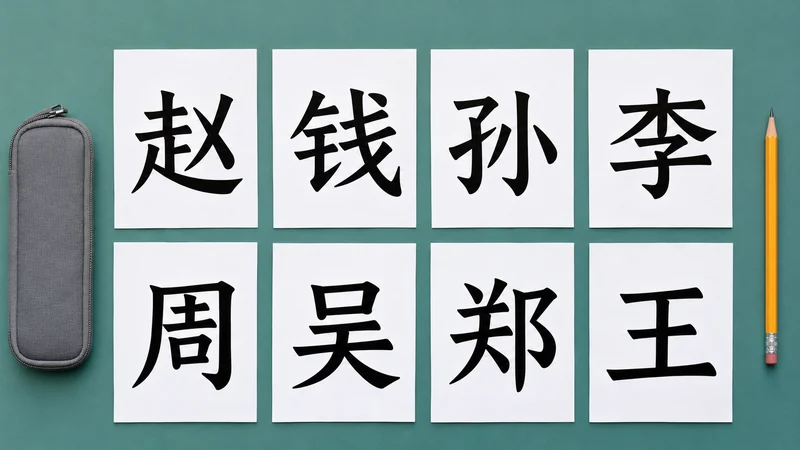
Quick Reference: positions 1–100, with Mandarin pinyin
The sequence and readings were checked against the publisher-hosted Tsinghua University Press preview, printed pages 9–10. Modern simplified forms are used for convenient lookup. Capitalization is editorial; tone marks identify the listed Mandarin reading, not every dialect pronunciation or family's established English spelling.
| Text position | Character | Mandarin pinyin |
|---|---|---|
| 1 | 赵 | Zhào |
| 2 | 钱 | Qián |
| 3 | 孙 | Sūn |
| 4 | 李 | Lǐ |
| 5 | 周 | Zhōu |
| 6 | 吴 | Wú |
| 7 | 郑 | Zhèng |
| 8 | 王 | Wáng |
| 9 | 冯 | Féng |
| 10 | 陈 | Chén |
| 11 | 褚 | Chǔ |
| 12 | 卫 | Wèi |
| 13 | 蒋 | Jiǎng |
| 14 | 沈 | Shěn |
| 15 | 韩 | Hán |
| 16 | 杨 | Yáng |
| 17 | 朱 | Zhū |
| 18 | 秦 | Qín |
| 19 | 尤 | Yóu |
| 20 | 许 | Xǔ |
| 21 | 何 | Hé |
| 22 | 吕 | Lǚ |
| 23 | 施 | Shī |
| 24 | 张 | Zhāng |
| 25 | 孔 | Kǒng |
| 26 | 曹 | Cáo |
| 27 | 严 | Yán |
| 28 | 华 | Huà |
| 29 | 金 | Jīn |
| 30 | 魏 | Wèi |
| 31 | 陶 | Táo |
| 32 | 姜 | Jiāng |
| 33 | 戚 | Qī |
| 34 | 谢 | Xiè |
| 35 | 邹 | Zōu |
| 36 | 喻 | Yù |
| 37 | 柏 | Bǎi |
| 38 | 水 | Shuǐ |
| 39 | 窦 | Dòu |
| 40 | 章 | Zhāng |
| 41 | 云 | Yún |
| 42 | 苏 | Sū |
| 43 | 潘 | Pān |
| 44 | 葛 | Gě |
| 45 | 奚 | Xī |
| 46 | 范 | Fàn |
| 47 | 彭 | Péng |
| 48 | 郎 | Láng |
| 49 | 鲁 | Lǔ |
| 50 | 韦 | Wéi |
| 51 | 昌 | Chāng |
| 52 | 马 | Mǎ |
| 53 | 苗 | Miáo |
| 54 | 凤 | Fèng |
| 55 | 花 | Huā |
| 56 | 方 | Fāng |
| 57 | 俞 | Yú |
| 58 | 任 | Rén |
| 59 | 袁 | Yuán |
| 60 | 柳 | Liǔ |
| 61 | 酆 | Fēng |
| 62 | 鲍 | Bào |
| 63 | 史 | Shǐ |
| 64 | 唐 | Táng |
| 65 | 费 | Fèi |
| 66 | 廉 | Lián |
| 67 | 岑 | Cén |
| 68 | 薛 | Xuē |
| 69 | 雷 | Léi |
| 70 | 贺 | Hè |
| 71 | 倪 | Ní |
| 72 | 汤 | Tāng |
| 73 | 滕 | Téng |
| 74 | 殷 | Yīn |
| 75 | 罗 | Luó |
| 76 | 毕 | Bì |
| 77 | 郝 | Hǎo |
| 78 | 邬 | Wū |
| 79 | 安 | Ān |
| 80 | 常 | Cháng |
| 81 | 乐 | Yuè / Lè |
| 82 | 于 | Yú |
| 83 | 时 | Shí |
| 84 | 傅 | Fù |
| 85 | 皮 | Pí |
| 86 | 卞 | Biàn |
| 87 | 齐 | Qí |
| 88 | 康 | Kāng |
| 89 | 伍 | Wǔ |
| 90 | 余 | Yú |
| 91 | 元 | Yuán |
| 92 | 卜 | Bǔ |
| 93 | 顾 | Gù |
| 94 | 孟 | Mèng |
| 95 | 平 | Píng |
| 96 | 黄 | Huáng |
| 97 | 和 | Hé |
| 98 | 穆 | Mù |
| 99 | 萧 | Xiāo |
| 100 | 尹 | Yǐn |
The preview prints Yuè for 乐 and explicitly notes that Lè is also a surname reading. A family's own pronunciation should be recorded rather than corrected from this single table. Likewise, the reading Rén belongs to 任 as listed here; an ordinary word's pronunciation is not automatically its surname reading.
Same romanization, different surnames
Compare positions 24 and 40: 张 and 章 both appear as Zhāng. Removing the tone mark does not make them one character, and retaining it still does not distinguish this pair. An English record reading Zhang therefore needs another identifier before it can be matched to a Chinese surname entry.
The table also contains several different Yu and Yuan entries: 俞 at 57, 于 at 82, 余 at 90, 袁 at 59, and 元 at 91. Some of their marked Mandarin readings coincide. These are separate written names, not alternate spellings to combine without evidence. The table shows the ambiguity rather than resolving a particular person's identity.
Take a small practical example. A relative recalls “Yu,” while a dated family document shows 余. You can record the documented character and consult its entry. If the character has not been found, keep it undecided instead of choosing 余 merely because it appears on this page. FamilySearch's Chinese names guide explains why original characters and family-linked material matter in this research.
For a closer illustration of that problem, the Yu surname guide separates several characters and their public origin accounts. It is not a test that identifies a surname from the Latin letters alone.
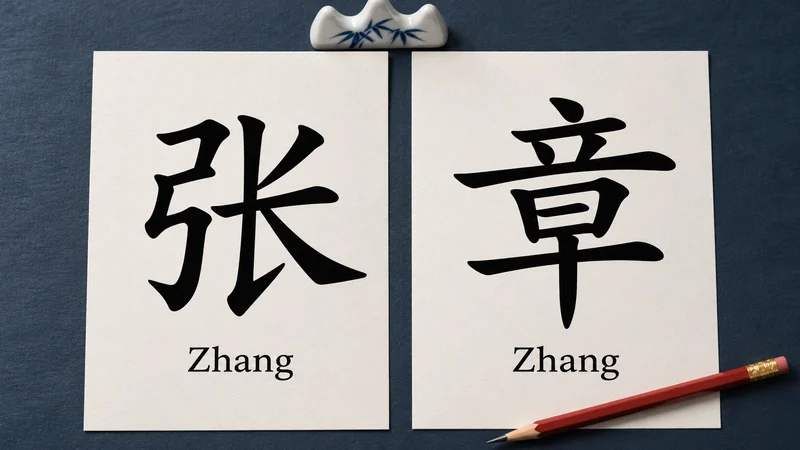
A simplified table is not a transcription of an old record
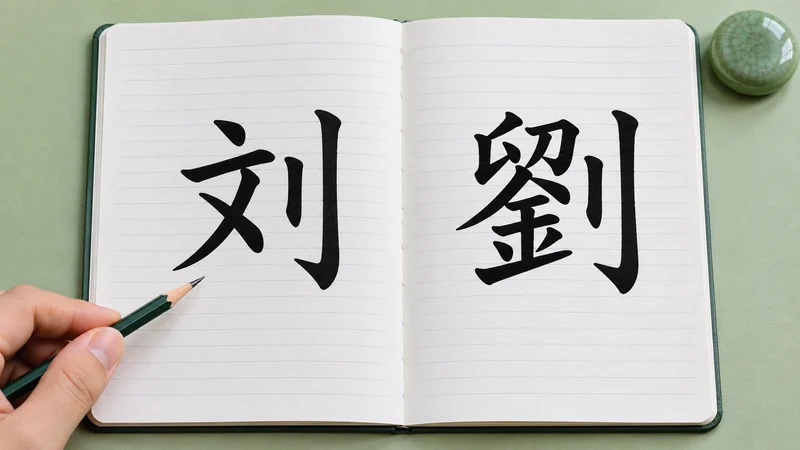
This list uses 刘 elsewhere in the wider classic, for example, while a traditional-script document may show 劉. The illustration below shows those two forms as a modern learning exercise; Liu is not among the first 100 entries displayed above. A visible form difference can concern writing convention rather than a separate surname. That is a different issue from 张 versus 章, which are distinct characters.
When copying an actual record, preserve what is written. Put a modern lookup form in a separate note instead of silently replacing the inscription. A worn character, a handwritten variant, a regional spelling and a modern pinyin transcription are different layers of evidence; a tidy table cannot decide all four for you.
There is also no reason to infer status from position. Zhao's first place does not prove that a modern Zhao family is royal; Yin's hundredth place does not make it less authentic. The classic's sequence provides a learning and reference order. A connection between named relatives still depends on documents, places and dates.
Questions about the list's limits
Are these the 100 most common Chinese surnames today?
No. They are the first 100 entries in the classic sequence used here. A modern frequency ranking would need a named population dataset, geographic scope and date, none of which can be supplied by numbering this text.
Why is my surname missing?
This extract stops at position 100, not at the end of Baijiaxing or at the edge of Chinese naming practice. Absence from this table does not show that a surname is invalid, rare or non-Chinese.
Can I use these readings for every person with that character?
Use them as the stated Mandarin reference readings. Ask the person or consult family-linked material for their own language variety, pronunciation and established romanization. The 乐 entry itself demonstrates why a single reading should not be forced on every family.
Does finding the same character prove a common ancestor?
No. A shared character is an identification clue, not a documented chain of descent. The surname list does not connect two named people across generations.