 Chinese Surname Guide
Chang Surname Origin: Character, Romanization, and Records
Chang can represent several different Chinese surnames, so the written character must come before an origin claim.
Quick answer: Chang may be the Wade-Giles spelling of 張/张 or 章, both written Zhāng in pinyin, or it may represent 常, written Cháng. These are distinct surnames with different recorded and traditional origin accounts. A dictionary of family names links 章 to an ancient fief called 鄣, records several historical and legendary traditions for 張, and records fief-name and surname-change traditions for 常. Confirm the character in a family document before applying any one account to a particular Chang family.
Which Chinese surnames can appear as Chang?
- 張/张
- Zhāng in pinyin; Chang in Wade-Giles
- 章
- Zhāng in pinyin; also Chang in Wade-Giles
- 常
- Cháng in pinyin; Chang without a spelling-system change
- What the spelling does not prove
- One character, ethnicity, clan, or lineage
- Best first document
- A family-connected source that shows the original character
- Research standard
- Label traditional origin accounts separately from documented relationships
Match Chang to the written surname before choosing an origin
The question “What is the Chang surname origin?” sounds singular, but Chang does not identify one written name. The University of Pittsburgh Library's pinyin and Wade-Giles conversion table maps pinyin zhang to Wade-Giles chang. This explains why 張/张 and 章, both pronounced Zhāng in Mandarin, can appear as Chang in older or Taiwan-linked records. 常 is different: its pinyin is Cháng, so Chang may also be a direct tone-free spelling of that surname.
The Dictionary of American Family Names entry for Zhang treats 張 and 章 separately. It connects 章 with the ancient fief 鄣 and records several different historical and legendary traditions for 張. Its Chang entry records several traditions for 常, including origins from named fiefs and the change from 恒 to 常 under a Northern Song naming taboo. “Said to be” and legendary accounts are surname traditions, not proof of an individual family's ancestry.
Begin with a source tied to the family: a birth or marriage certificate, household record, clan book, gravestone, ancestral tablet, association record, school document, handwritten letter, or immigration file. Copy the character exactly. Record the document title, date, place, person named, and where the item came from. If no character is available, write “Chang, character not yet confirmed” instead of filling the blank from a surname list.

Separate spelling history from family history
Romanization answers how a name was written in the Latin alphabet. Genealogy asks whether named people belong to the same family line. The two questions overlap, but they are not interchangeable. A spelling change may reflect a new indexing system, a different language environment, or an official choosing one form on a document. None of those events automatically changes the family's written surname.
The Pittsburgh conversion table proves only the spelling-system relationship between zhang and chang; it does not prove that a person used 張 rather than 章, or that two people share ancestry. The Library of Congress explains that its pinyin romanization guidelines were created to make Chinese personal and place names more consistent in catalog records. For family research, an old spelling should remain visible even when a researcher adds a modern pinyin search form.
Do not silently rewrite a historical record. Enter the name exactly as shown, then add separate fields for the confirmed character, language or dialect if known, and modern search variants. This makes the research trail reversible: another person can see which spelling came from the document and which was added later.
Build a record trail across migration and name changes
Once the character is known, move from surname lists to records about people. Start with the most recent verified person and work backward one relationship at a time. For each person, capture the full name as written, the original character if present, birth or residence place, approximate dates, relatives, occupation, addresses, and any file or certificate number.
The U.S. National Archives notes that records created under Chinese exclusion policies are important sources for Chinese and Chinese American family history. Its research guide explains that immigration and federal court files are organized by record group and may connect to one another through case numbers. It also warns that access can depend on the age of the file and privacy restrictions.
The National Archives at Seattle gives more concrete examples: some case files include applications, identity photographs, interrogation transcripts, court records, official correspondence, and personal letters or photographs. Interrogations may contain information about family members and communities. These examples show what is possible, not what every Chang family will find.

Test an origin story against places, dates, and relatives
Family stories are valuable leads, especially when records are scarce. The safe method is to preserve the story in the words of the person who told it, then test each part separately. If the account says the family came from a named county, used a particular character, and changed its spelling after migration, those become three research questions rather than one inherited conclusion.
Suppose a family remembers a grandfather called “Chang Wei” who arrived through Seattle. A passenger list shows “Cheung Wai,” while a later school record shows “W. Chang.” The overlap is interesting, but the names alone do not establish identity. Compare dates, home village, spouse or sibling names, address, occupation, photographs, signatures, and file numbers. A shared relative and matching village are stronger than a similar spelling. A conflicting birth date should be recorded, not hidden.
Use a table with one row per document. Keep the document's wording in one column and your interpretation in another. If the evidence points in two directions, leave the conclusion open and identify the next record that could resolve it.
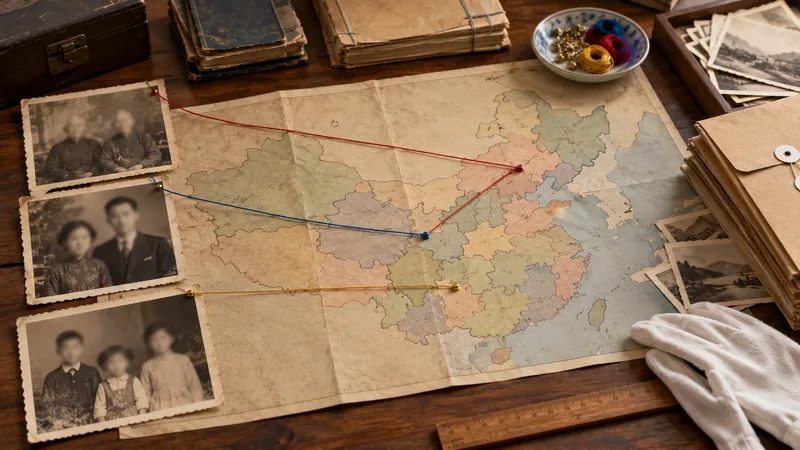
Handle conflicting spellings without choosing too early
A family file may contain Chang, Cheung, Chong, Zhang, or another form that looks related. Do not merge them merely because an online table places them near one another. Ask which document carries the original character, which language environment produced each spelling, and whether the people share independent identifiers.
Create an alias field for every spelling attached to a verified person. Search catalogs and databases under each form, but keep the results separate until dates, places, and relatives agree. If two spellings lead to different characters, stop treating them as automatic variants. If the character is the same but the people differ, the shared surname still does not prove a close family relationship.
This approach is especially useful when indexes were created from handwriting. A transcription may be wrong even when the original document is correct. Save an image or archive citation so the reading can be checked later.
Evidence ladder for a Chang family record
| Evidence | What it can establish | What still needs checking |
|---|---|---|
| Chang in a modern profile | The spelling used in that profile | Original character and earlier forms |
| Character on a family document | The written surname in that source | Whether other records refer to the same person |
| Matching place and date | A stronger identity comparison | Relatives, occupation, address, and record numbers |
| Named parent, spouse, or sibling | A possible relationship link | Independent documentation connecting both people |
| Family origin story | A research lead worth preserving | Sources for its character, place, dates, and generations |
| Linked records across generations | A documented family chain | Remaining conflicts and missing intervals |
For the first step, use the surname character guide. For pronunciation and spelling context, see Chinese surname pronunciation. Then use the family-record checklist to track evidence without turning a clue into proof.
Questions about researching the Chang surname
Does Chang always represent the same Chinese surname?
No. Chang is a Latin-alphabet spelling used in different places and periods. It does not prove one Chinese character, language, or family line. Confirm the character in a family-connected source.
Can I identify a Chang family character from English spelling alone?
Not reliably. Use the spelling to search, but confirm the original character on a certificate, register, gravestone, family book, association record, or immigration file.
Should I replace an older spelling with modern pinyin?
No. Preserve the spelling exactly as each source records it. You can add a modern romanization as a research note after the character and language context are known.
What can Chinese exclusion case files contain?
Some National Archives case files contain applications, photographs, interrogation transcripts, court records, correspondence, and information about family or community ties. Contents and access vary by file.
How do I test a Chang family origin story?
Compare the claimed character, place, time period, named relatives, and migration path with independent records. Keep the story labeled as a tradition until a linked record chain supports it.
Sources and research notes
- Library of Congress pinyin romanization guidelinesCataloging guidance for Chinese personal names, place names, and alternative forms.
- National Archives guide to Chinese immigration recordsRecord-group context, family-history value, access limits, and links between federal files.
- Chinese Exclusion Act records at the National Archives at SeattleExamples of forms, photographs, transcripts, court records, correspondence, and family information found in some case files.
- Unicode Standard Annex #38: UnihanTechnical documentation for Han character readings, mappings, variants, and source data.
These sources support the research method and record descriptions. They do not identify the character or ancestry of an individual Chang family.