Xu Surname Origin: Character, History, and Family Record Checks
Research Xu surname origin with Chinese character checks, spelling variants, history context, and safe family-record notes.
Xu surname origin should start with the written Chinese character and source record. English Xu can be useful, but the safest family note confirms the character, older spelling, place, and document before making ancestry claims.
Xu surname research facts
- Source record
- Family book, certificate, inscription, association record, or bilingual document
- Character variant
- Confirm the exact written form before interpreting origin
- Origin evidence
- History context plus family-specific records
- Spelling risk
- Xu, Hsu, Hui, or other romanized forms may appear in older records
- Research use
- Genealogy note, family explanation, student project, or name lookup
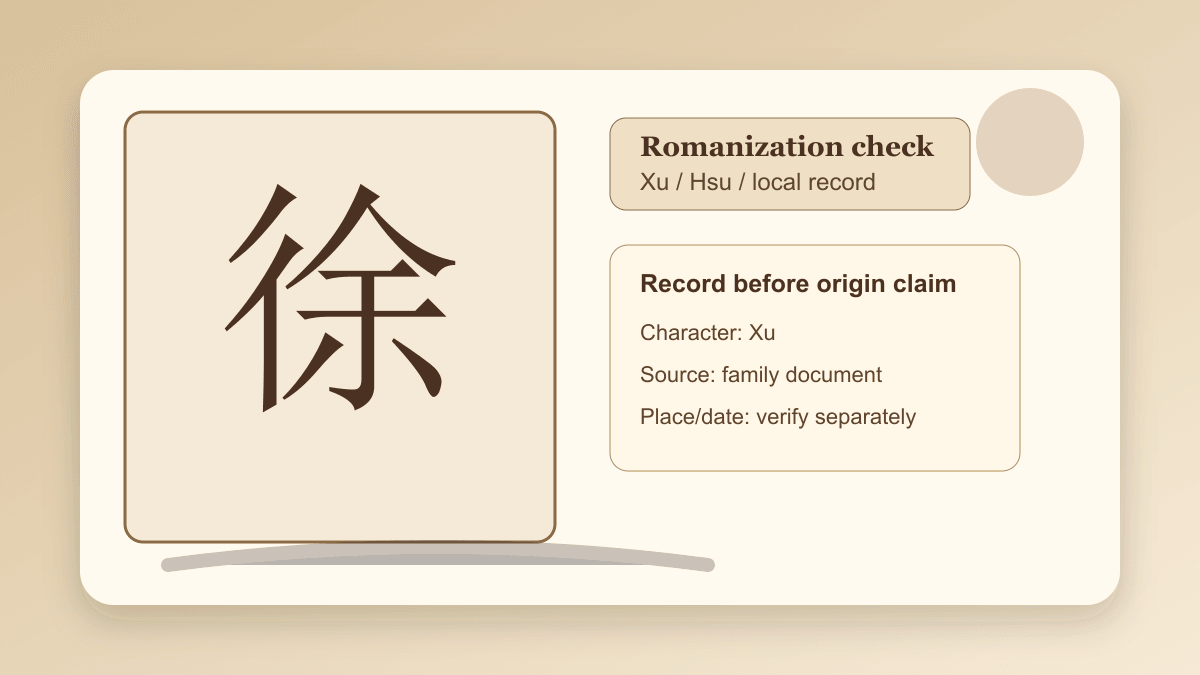
Confirm the written character
Surname research should begin with the Chinese character. English spelling is helpful for searching, but it can hide dialect spelling, older romanization, and document changes.
If two sources use different spellings, keep both spellings in the note and connect each one to the record where it appears. For Xu, this is especially useful because the same family may see one spelling in an English certificate, another in an association roster, and the Chinese character in a family book. Treat those as linked evidence, not as interchangeable shortcuts.
Separate public history from family proof
A surname can have well-known historical accounts without proving a private family branch. Public history gives context; family proof comes from documents, places, and repeated records.
This distinction makes the page useful for readers who want a responsible explanation rather than a confident but unsupported lineage claim. A public origin paragraph can explain why the surname matters culturally, while the family note should still say which source was checked, what place name appears, and which details remain uncertain.

Build a reusable family note
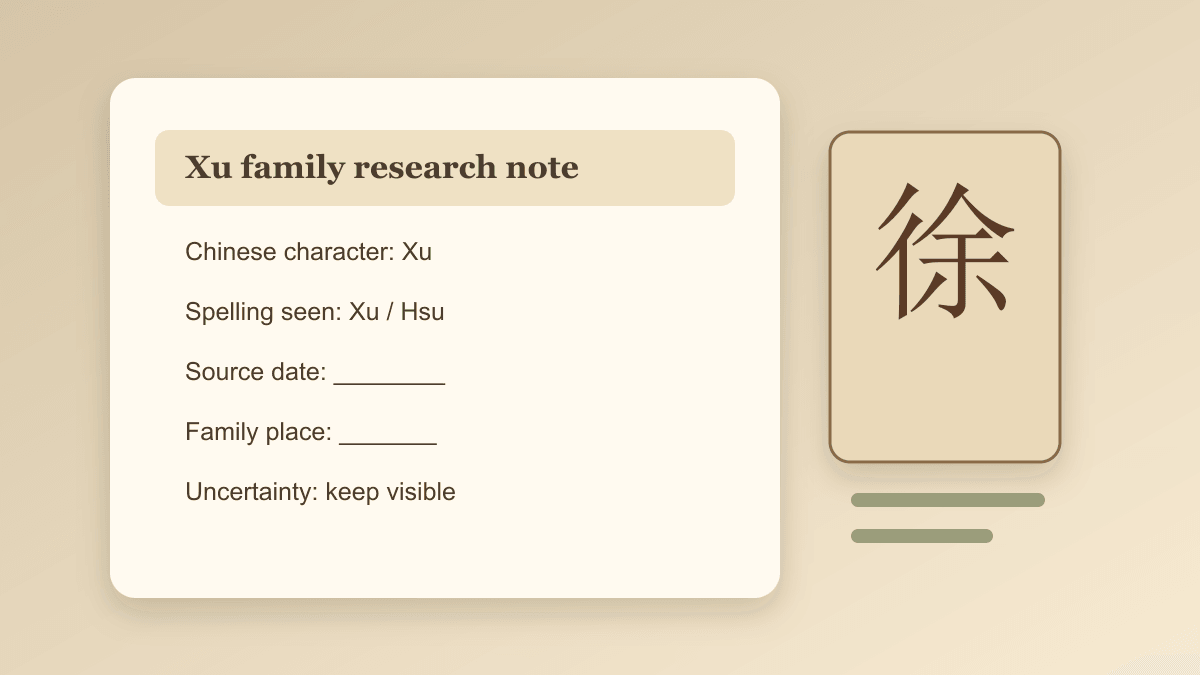
A good note lists the character, spelling, source date, family place, and uncertainty. It can then be reused in a family tree, school project, gift card, or bilingual explanation. For Xu surname origin research, the note should not try to settle every historical question at once. Its job is to keep the evidence visible enough that another relative can check the same character, spelling, and source later.
When a detail is not known, state that clearly. A transparent note is more trustworthy than a tidy origin story with missing evidence.
Surname record checklist
- Save the Chinese character and English spelling together.
- Record the source document and date.
- Keep regional place names separate from surname-wide history.
- Mark uncertain details instead of smoothing them away.
Xu surname questions
What should I confirm before explaining Xu surname origin?
Confirm the written Chinese character, source record, spelling variant, and family place if available.
Is English Xu enough for genealogy research?
No. English spelling alone can hide character and romanization differences.
Can public surname history prove my family branch?
No. It gives context, but private ancestry needs family-specific evidence.
What should a Xu family note include?
Include character, spelling, source, date, place, and any uncertainty that still needs evidence.