 Chinese Surname Guide
Deng Surname Origin: 邓, 鄧, and the Place-Name Account
For Deng, the written surname is a better starting point than an English word translation. 邓 and 鄧 identify a surname with a place-name tradition, but recognizing that tradition is different from identifying a modern family's ancestors.
Quick Answer: The Deng surname origin is traditionally connected with Deng, an ancient state or territorial name written 鄧, simplified 邓. The Mandarin reading is Dèng. The Kangxi Dictionary's surname discussion, reproduced by ZDIC, attributes an account to Xingkao in which King Wu Ding's uncle received the title Marquis of Deng and the name was later adopted as a surname. That is an attributed origin tradition, not proof that every Deng family descends from one documented founder.
The written name and the evidence behind it
- Simplified form
- 邓.
- Traditional form
- 鄧; a script counterpart of 邓, not a separate surname on that basis.
- Mandarin pinyin
- Dèng, fourth tone, from the dictionary reading.
- Early lexical connection
- The Shuowen entry describes 鄧 as the name of a state of the Man (曼) clan.
- Attributed surname account
- Kangxi cites Xingkao for a title-to-surname tradition involving Wu Ding's uncle.
- Family-history limit
- The surname or origin narrative alone does not establish a person's generations, ethnicity or clan.
Pronunciation is attributed to the dictionary reading. Origin narratives are attributed to the named works reproduced in that entry; neither is a substitute for a personal family record.
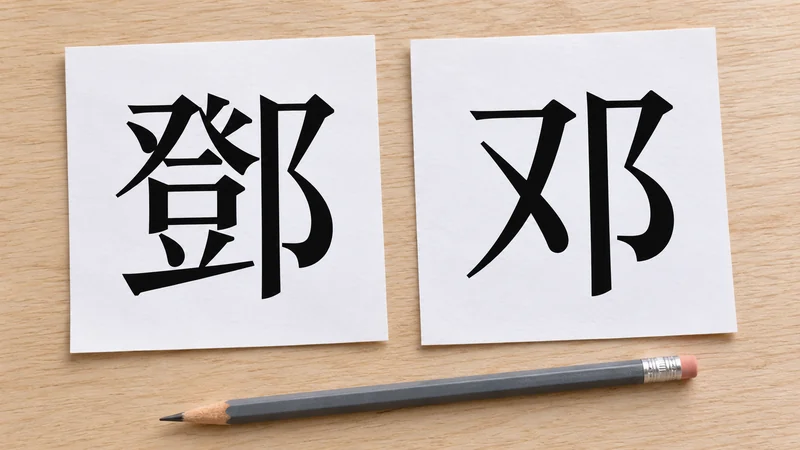
邓 and 鄧 identify the written surname before its story
The ZDIC entry for 邓 gives the Mandarin reading dèng and identifies it as a surname, with 鄧 as its traditional form. The 鄧 entry supplies the corresponding reading and historical dictionary material. In English prose, the surname is conventionally capitalized as Deng; the tone-marked pinyin Dèng clarifies the Mandarin reading.
A record using 鄧 and one using 邓 can therefore be using two script forms of the same surname character. The change in written form alone does not demonstrate a surname change, an adoption or a newly discovered branch. Preserve the form actually written in each source rather than replacing all older occurrences in a transcription.
Nor should Deng be translated by selecting a pleasant meaning from a similar-looking character. The relevant lexical evidence here is a surname and a place-name connection. It does not establish that a person has a particular temperament, occupation or ancestral hometown. If all you have is the Latin spelling, confirm the original written name before applying this character-specific account.
The state-name connection comes from a specific entry
Under Shuowen Jiezi, the 鄧 entry describes a state associated with the Man clan and locates it in the Nanyang geographical frame used by the text. That is direct support for discussing an ancient place or state name, rather than treating Deng as an English-style descriptive surname.
Keep the scope of that evidence clear. A lexical entry identifying a state name is not itself a list of everyone who later inherited the surname. The character's place-name use and the process by which a particular family acquired it are related questions, but they require different kinds of evidence.
This distinction also avoids an unnecessary leap from an old geographical description to a modern birth certificate. A contemporary Deng family living elsewhere is not disproved by the dictionary's Nanyang reference; conversely, a family living near a place called Deng is not thereby proved to descend from the state's rulers. The dictionary establishes the account to investigate, not the missing relationships.
Read the Wu Ding account as an attributed surname tradition
The surname paragraph in the Kangxi Dictionary material goes further than the state definition. Citing Xingkao, it describes Wu Ding of the Shang granting his uncle a territory or title associated with Deng, followed by adoption of that name as a surname. This is the source layer behind the title-to-surname explanation summarized above.
It is reasonable to say that this reference preserves a traditional account linking the surname with the Marquis of Deng. It is not reasonable to turn the short passage into a verified pedigree for an unnamed reader. The entry supplies no continuous set of parent-child records joining that ancient figure to every later Deng family.
The distinction is not a claim that the tradition must be discarded. A family can preserve it as an origin narrative while separately documenting the generations it can actually trace. Write 'the cited surname tradition relates...' when describing the account, and reserve 'our ancestor' for a relationship supported by that family's evidence.
Not every historical place called Deng is the same location
The same 鄧 entry records more than one geographical use, including a place in Lu and another associated with Cai. Its Kangxi material even discusses why a particular Deng meeting-place should not simply be identified with the small state. The identical character is not sufficient reason to collapse all these locations into one.
When reading a quoted passage, keep its work, period and surrounding place names attached. An isolated name copied into a family notebook may lose the context needed to distinguish a state, town or later administrative name. Do not put an exact modern map pin into that gap without a source that supports the identification.
For the surname question, this means keeping the broad place-name explanation separate from a precise ancestral address. A dictionary can offer useful leads, but the location of a known family needs its own records. No migration route or present-day county of origin is inferred here from Deng alone.
A family note can preserve both the spelling and the uncertainty
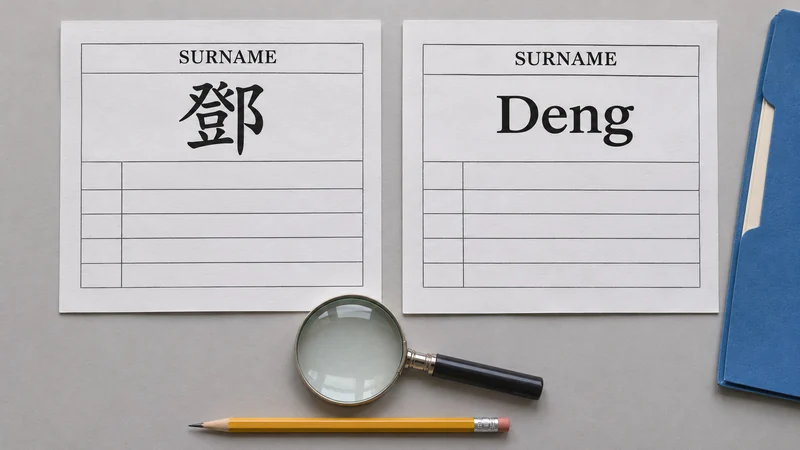
Consider an illustrative pair of records: one has a surname field written 鄧, while another transcribes the family name as Deng. The two spellings may be compatible, but that alone does not identify the people as the same person or as relatives. Compare the full names and whatever dates, places and relationships the records actually provide.
If the surname field itself is unclear, the surname-versus-given-name guide explains why field labels and a person's verified presentation matter. The name-order guide covers display and form handling. Neither is being recommended as a tool that reconstructs an unknown character or proves ancestry.
A careful summary might read: 'The record writes 鄧, corresponding to simplified 邓 and Mandarin Dèng. The dictionary preserves a Deng place-name and surname tradition; our documented family line is a separate question.' That gives the cultural answer without filling an undocumented generational gap with a famous name.
Quick Reference: four different questions about Deng
| Question | Evidence to consult | What the answer does not prove |
|---|---|---|
| Which written surname? | The actual 鄧 or 邓 in a family or official record | That two bearers are related. |
| How is it read in Mandarin? | The dictionary's dèng reading | Every regional pronunciation or legal spelling. |
| What origin account is preserved? | Shuowen's state entry and Kangxi's cited Xingkao account | A continuous personal pedigree. |
| Where did this family live? | That family's dated and identified records | A hometown inferred only from the surname. |
The two dictionary pages are linked below. Original text, pronunciation and personal genealogy have separate evidence roles.
Questions about Deng's forms and origin account
Are 邓 and 鄧 different Chinese surnames?
Not on the basis of those forms alone. 邓 is the simplified form and 鄧 the traditional form of the surname character discussed here.
How is Deng pronounced in Mandarin?
The dictionary gives Dèng, with a fourth-tone mark. This is a Mandarin reading, not a claim that every region or family uses the same spoken form.
Does Deng mean an ancient state?
The historical character entry describes Deng as a state name, and a cited surname tradition connects a territorial title with surname adoption. That is more specific than assigning a generic English personality meaning.
Does the Wu Ding account identify my ancestor?
No. It is an attributed surname-origin tradition. Identifying your own ancestors requires evidence connecting actual people and generations.
Can I infer a modern hometown from Deng alone?
No. The dictionary records several historical place-name uses, and a shared surname does not establish a particular family's home county or migration route.
Character entries and the works they cite
- ZDIC 邓: simplified form, Mandarin reading and surname usage
- ZDIC 鄧: Shuowen state-name entry and Kangxi's Xingkao surname account
Dictionary pages read November 4, 2026. The historical accounts above are paraphrased and attributed through the cited entries, not presented as newly verified ancient genealogies. Modern illustrations are not archival records or archaeological reconstructions.