 Chinese Surname Guide
Ding Surname Origin: 丁, Dīng, and the Different Family Accounts
Ding looks like a simple four-letter surname, but that spelling can conceal different written names. Begin with the character; then ask which source supports the history attached to it.
Quick Answer: For the Chinese surname 丁, the Mandarin reading is Dīng. A surname dictionary reproduced by FamilySearch lists several origin accounts, including Duke Ding of Qi and an official called Marquis Ding. These are surname traditions, not a verified family tree for every bearer. Ding can also represent other characters, so confirm the written surname before applying the 丁 account.
丁, its reading, and the source distinctions
- Surname character
- 丁
- Mandarin pinyin
- Dīng, first tone, from the Ministry of Education dictionary.
- Character meanings
- The dictionary lists several uses, including adult man, population and surname.
- Origin source
- FamilySearch reproduces the Dictionary of American Family Names.
- Other written sources
- The surname entry also lists 鄧 and 陳 under Ding spellings.
- Genealogy boundary
- A shared spelling or origin tradition does not prove a shared ancestor.
Pronunciation and character senses below come from dictionaries. The surname-history accounts have a separate attribution; FamilySearch is not being cited as a tone-marked pronunciation dictionary.
Identify 丁 before translating Ding
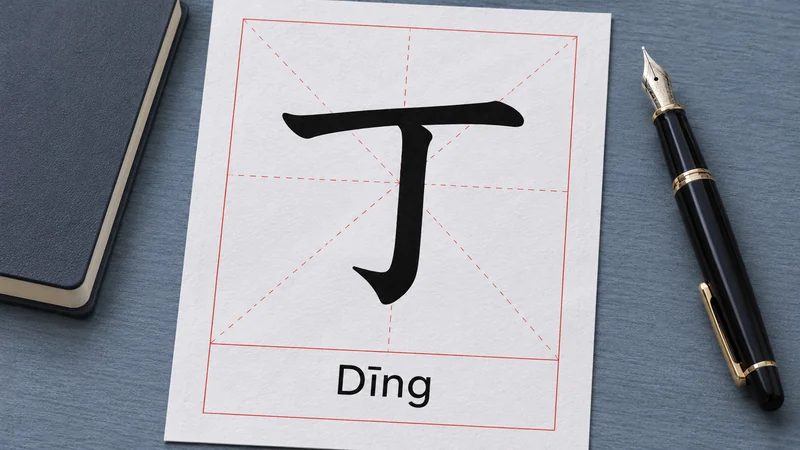
The Ministry of Education's concise dictionary gives 丁 as dīng and includes its use as a surname. In English discussion of a family name, Dīng makes that Mandarin first-tone reading explicit. Preserve the family's actual legal spelling rather than adding a tone mark to an official record that does not use one.
The character also has ordinary vocabulary senses: the same dictionary includes an adult man, population and the fourth heavenly stem. A surname does not mean that each of these senses describes the person carrying it. Nor does selecting a modern English gloss explain how a particular family acquired its name.
The Ministry's revised dictionary likewise places surname usage under dīng. It also lists zhēng for other vocabulary, so the presence of another reading is not a reason to assign it to the surname. The modern practice sheet below illustrates 丁 and its surname reading; it is not a reproduction of an ancestor's handwriting or proof of an ancient surname origin.
The Duke Ding and Marquis Ding traditions
The Ding entry on FamilySearch, credited to the Dictionary of American Family Names, includes an account connected to Duke Ding of Qi, a posthumous title, and another connected to an official called Marquis Ding in the late Shang period. These are two different attributed explanations, not successive generations of one demonstrated family tree.
The distinction between a personal name and a title matters here. ‘Duke Ding’ should not silently become a modern-style full name whose first word is a given name and second word a hereditary surname. When summarizing the account, retain what the reference actually calls the name or title instead of inventing a missing chain of descendants.
A careful origin note can therefore say that a named surname reference preserves these accounts. It cannot conclude, from Ding alone, that a reader descends from either figure. Keeping the traditional story and the documented family line separate allows both to be discussed without dismissing the tradition or treating it as a personal certificate.
One Latin spelling can hide another character
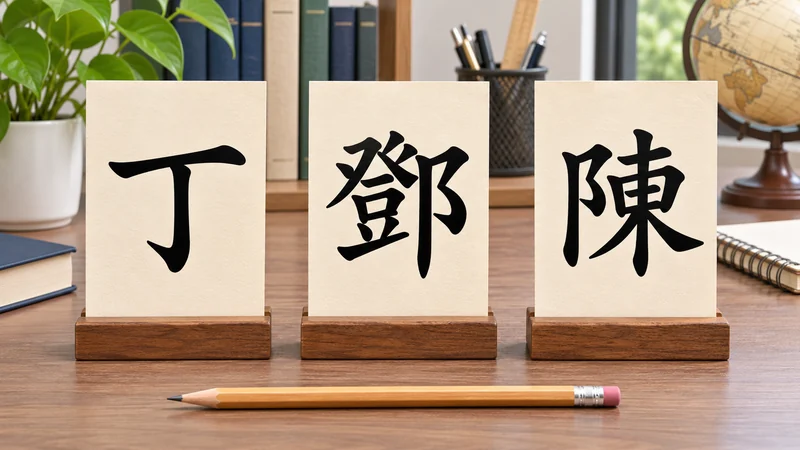
The same FamilySearch entry also lists Ding as a regional romanization of 鄧 and, possibly through Fuzhou pronunciation, 陳. Those written surnames must not be assigned the 丁 account merely because the Latin letters match. The entry also contains a separate English surname explanation, another reason not to infer a Chinese origin from spelling alone.
The comparison is about possible written identities, not a claim that every Ding family uses one of exactly three characters. Ask what appears in that family's own source. If it is 鄧, the Deng character and origin guide discusses that surname specifically; it is not a replacement history for someone whose record actually says 丁.
Record the spelling as well as the character when both are available. A passport form, a modern contact list and an older handwritten source can present a name differently. A mismatch is a question to investigate, not permission to normalize every occurrence to whichever spelling a search engine returns first.
Separate an origin note from a family conclusion
Suppose a family note says 丁 and an English form says Ding. Those entries may be compatible, but the matching surname alone does not establish that the documents concern the same individual. Compare the full names, places, dates and relationships that the actual documents provide. Do not fill a missing relationship with a famous bearer of the name.
Keep a short source note beside each statement: ‘dictionary reading,’ ‘surname-origin account,’ ‘relative's recollection’ or ‘recorded relationship.’ These labels are an organizational suggestion, not a claim that an archive has already verified the family. They make it easier to see when a cultural explanation has accidentally been promoted into an assertion about a specific person.
When a full name has been split into fields, the surname-versus-given-name guide explains why field labels and the person's verified presentation matter. It is being recommended for that limited task, not as a tool that recovers an unknown character from Ding or reconstructs a pedigree.
Write a useful summary without overstating the evidence
For a record confirmed as 丁, a concise summary might read: ‘The surname character is 丁, Mandarin Dīng. A cited surname dictionary preserves more than one origin tradition. The generations documented for this family are a separate record-based question.’ Replace the final sentence with actual relationships only when the relevant evidence has been checked.
Leave ethnicity, religion, exact birthplace and clan identity out of the conclusion unless sources about the family support them. A surname dictionary is a starting point for understanding a name, not a reason to assign a community identity to someone you have not researched. The written character answers one question; a family's history requires more than the character alone.
Quick Reference: what each Ding source answers
| Question | Source to use | Limit |
|---|---|---|
| How is 丁 read in Mandarin? | Ministry of Education dictionary: dīng | Not every regional or family pronunciation |
| What does the character mean? | Dictionary senses in their own contexts | Not a personal trait or ancestral occupation |
| Which origin accounts are listed? | Named surname reference reproduced on FamilySearch | Not a continuous pedigree |
| Does this Ding spelling mean 丁? | Original family or official document | Latin letters alone are insufficient |
| Are two people related? | Evidence linking the actual people | A surname match is not enough |
The table separates linguistic information, surname tradition and individual evidence rather than asking one source to prove all three.
Ding characters and family-history questions
How do you write the Chinese surname Ding?
丁 is one written surname represented by Ding, but the spelling can have other sources. Confirm the character in a family or official document.
What is the Mandarin tone of 丁 as a surname?
The Ministry of Education dictionary gives dīng, first tone. The surname is written Dīng in tone-marked pinyin here.
Does the character's meaning identify an ancestor's occupation?
No. A vocabulary sense such as adult man or population does not by itself explain how a family acquired the surname.
Does the Duke Ding account prove my family descends from him?
No. It is an attributed surname-origin account, not evidence linking your documented generations to that figure.
Can two families spelled Ding have different Chinese surnames?
Yes. The cited surname reference includes more than one character under that spelling. Check the original written surname before applying a character-specific history.
Readings and surname accounts: separate sources
- Ministry of Education concise dictionary: 丁, dīng, surname and vocabulary senses
- Ministry of Education revised dictionary: 丁, surname under dīng and other vocabulary readings
- FamilySearch: Ding entry, credited to Dictionary of American Family Names
Sources read November 5, 2026. The Ministry dictionaries support meanings and Mandarin reading. FamilySearch reproduces an attributed surname reference, not a verified individual genealogy. The three contemporary illustrations are not archival documents.