 Chinese Surname Guide
Leong Surname Origin: Liang, Long, and the Character That Decides
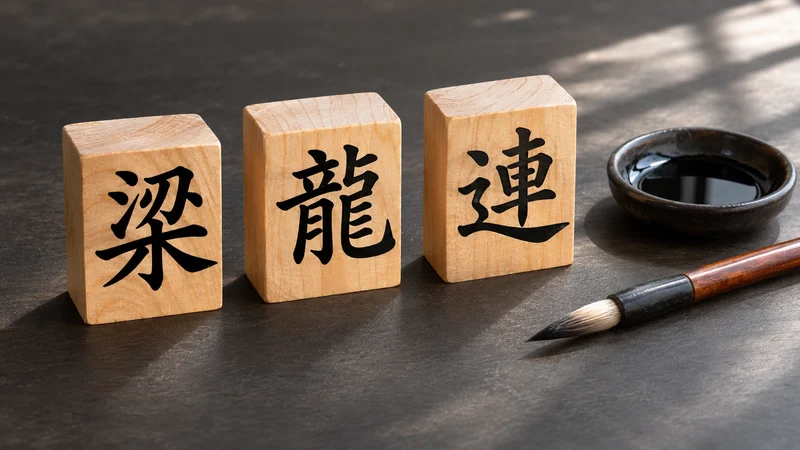
Quick Answer: Leong can represent more than one Chinese surname. The Dictionary of American Family Names, reproduced by Ancestry, identifies 梁, 龍, and 連 among its possibilities. For 梁, Leong is an alternative Cantonese spelling related to Mandarin Liang. Do not choose an origin story from the English spelling until you know which character your family used.
Three characters, not one universal Leong family
The Leong dictionary entry supplies the spelling relationships below. It is a surname reference, not evidence that every person named Leong belongs to a particular clan or language community.
Quick reference
| Character to look for | Related Mandarin spelling | What the Leong entry says |
|---|---|---|
| 梁 | Liang | An alternative Cantonese form |
| 龍; simplified 龙 | Long | A variant romanization, possibly reflecting Hokkien or Taiwanese pronunciation |
| 連; simplified 连 | Lian | Another variant romanization listed separately |
Keep the source's qualification “possibly” for 龍. A dictionary's account of a spelling does not prove the language used by your particular ancestor. Nor does finding one of these characters in someone's given name establish that it was their surname.
The entry's naming examples are more useful here than its changing record counts or distribution graphics. Those database displays should not be treated as a worldwide census or a complete history of the surname.
Quick Facts
- Character variants
- 梁, 龍 and 連 are listed possibilities
- Liang spelling relationship
- Leong is an alternative Cantonese form for 梁
- Origin source
- Surname dictionary entries, not private genealogical records
- Research boundary
- Confirm the character and person before combining records
If the character is 梁, what is the origin account?
The Liang entry gives meanings including roofbeam and bridge, then describes several surname-origin traditions. One connects the name to the ancient state of Liang near present-day Hancheng in Shaanxi. Others concern place names and families that adopted 梁 as a surname.
These are alternative explanations within a reference work, not a single continuous family tree. The character's ordinary meaning also does not prove that an ancestor built bridges or worked with roof beams. Treat a dictionary's historical account as background to test against records, rather than a ready-made biography.
This page's narrower question is why a record saying Leong may—or may not—belong with Liang records. The Yan surname guide offers a separate example of one romanized spelling covering different written surnames.

If the character is 龍 or 連, stop borrowing the Liang story
龍 is the character associated with the dragon; it is not another way to write 梁. FamilySearch's Long entry includes traditional accounts involving the legendary ruler Shun. Those accounts need to remain labeled legendary: the entry is not proof of a modern family's descent from a named ancient figure.
Likewise, the appearance of 連 in the Leong spelling entry is a reason to investigate Lian separately, not a reason to attach the state-of-Liang account to it. This guide does not identify an individual 連 family's origin from spelling alone. The Song surname guide likewise separates public surname history from evidence for one family; it does not identify a Leong family's character or origin.
A record comparison that changes the answer
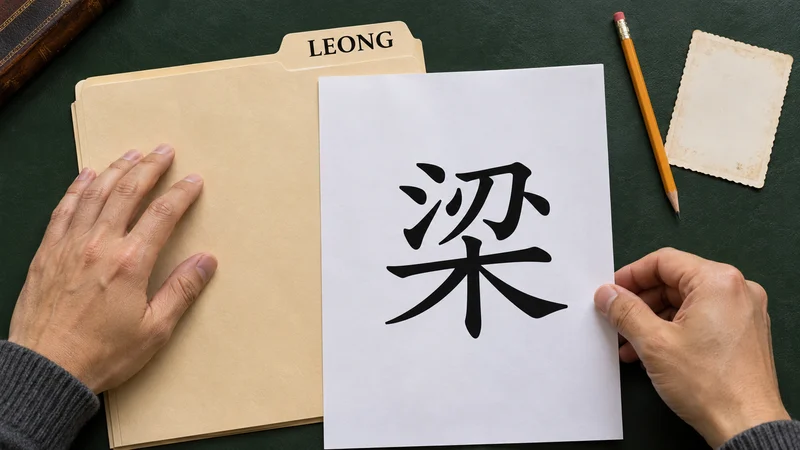
Suppose a family has an English certificate naming “Leong” and a separate Chinese document showing 梁 beside the same person's full name. Matching dates, relatives, and places may help establish that the documents refer to the same individual. Only after that connection is made does the 梁 surname discussion become relevant.
Now suppose the Chinese document shows 龍 instead. Similar English spelling is not grounds to replace it with 梁. Preserve what the document says and investigate the Long connection. If the character is unreadable, record the uncertainty rather than silently supplying the most familiar option.
This is a hypothetical comparison, not a claim about any actual family record. Its purpose is to keep two questions separate: Which written name is this? and What can be established about this person's family?
Questions about the Leong spelling
Are Leong and Leung always the same surname?
They can both refer to 梁, but that does not make every use of either spelling interchangeable. Confirm the original character and the person concerned before combining records.
Can I determine a clan or ancestral village from Leong?
Not from the spelling alone. A surname dictionary explains possibilities; a family connection requires records connecting named people, places, and generations.
Should I change an old record to modern Mandarin spelling?
Preserve its recorded spelling. You can add an explanatory cross-reference, such as “Leong; character 梁; Mandarin Liang,” when supported. Replacing the original text can erase a clue to how that record was created.