 Chinese Surname Guide
Yan Surname Origin: Three Characters, Three Histories
Quick Answer: The Yan surname origin depends on the character. 严 / 嚴, 阎 / 閻, and 颜 / 顏 are three Chinese surnames that can all be written Yan in English. Each is Yán in standard Mandarin, but the three have different origin accounts. If Yan is the only form you have, first look for the original character on a record tied to the person you are researching.
Which character does your record use?
Quick Reference
| Simplified | Traditional | Mandarin | What distinguishes this entry |
|---|---|---|---|
| 严 | 嚴 | Yán | A surname-change account involving 莊 (Zhuang) |
| 阎 | 閻 | Yán | Several place-name accounts; compare 闫 / 閆 separately when it appears on a record |
| 颜 | 顏 | Yán | Accounts linked to a personal name or place name in what is now Shandong |
The readings come from Taiwan's Ministry of Education dictionary entries for 嚴, 閻, and 顏. The histories below come from the Dictionary of American Family Names entry reproduced by FamilySearch. The table is not an exhaustive list of surnames spelled Yan. It is a way to separate three entries that sound alike in Mandarin.
Quick Facts
- Characters compared
- 严 / 嚴, 阎 / 閻, 颜 / 顏
- Mandarin pronunciation
- Yán for each of these entries
- Spelling clue
- Yan can also occur under the alternate spelling Yen
- Evidence for an individual
- Original character tied to a person, date and place
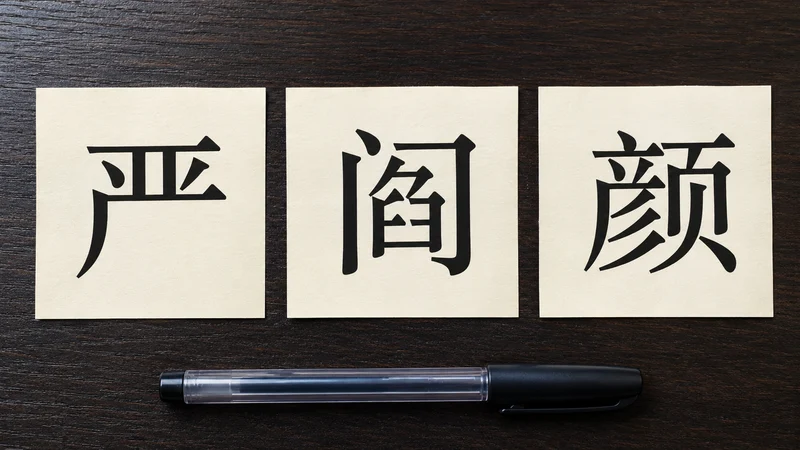
Three origin accounts, not one Yan family
严 / 嚴: The dictionary reports that people with the surname 莊 changed it to 嚴 during the Eastern Han reign of Emperor Ming, whose personal name included 莊. The account describes a name change to avoid using a character in the emperor's name. That gives a historical explanation associated with the surname. It does not show that a particular modern family changed its name during that reign.
阎 / 閻: The entry gives more than one place-name account, including a fief associated with present-day Henan and another associated with present-day Shanxi. Treat those places as clues from the surname literature, not as a map to an ancestor. The family-name dictionary lists 閆 separately and describes it as probably developing from 閻; the Ministry of Education dictionary lists 閆 among variants of 閻. In a transcription, keep the character the document actually uses instead of silently converting one into the other.
颜 / 顏: One account connects the surname with a name associated with Duke Wu of the state of Zhu. Another connects it to a fief called Yan associated with Bo Qin. The family-name dictionary locates both accounts in present-day Shandong. A modern record that gives 顏 confirms the character on that record; it does not tell you which account, if either, applies to the person's family.
When an old record only says Yan or Yen
Suppose an English-language passenger record gives Yan, while a family document with a matching full name gives 顏. Record the two spellings side by side. Use the birth year, locality, and names of relatives to check whether the documents actually refer to the same person. If the dates and family members do not line up, keep the match open even if the spelling looks right.
The FamilySearch entry for Yen includes it as an alternate romanization for several Chinese surnames. Use Yen as an additional search spelling where a family record supports it, not as a reason to replace the spelling on an original record. For a document with an unfamiliar name order, the Chinese family name order guide explains how to compare the surname and given-name fields.
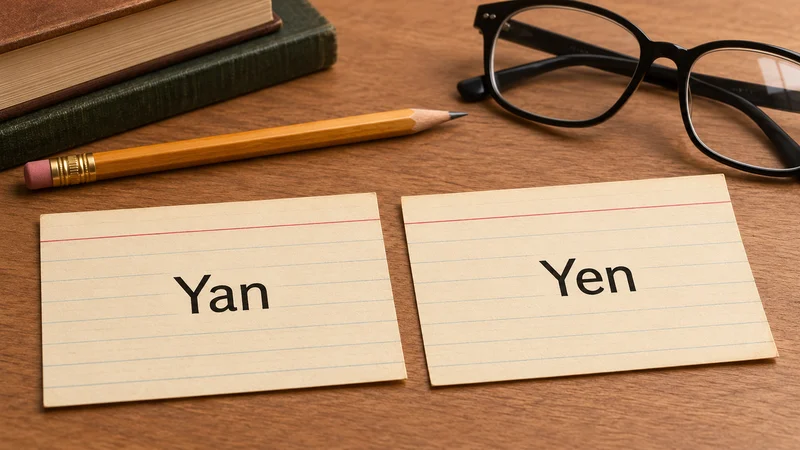
What to record before looking farther back
For each document, keep an image or citation, the surname exactly as written, the date and place, and the evidence that connects it to your family member. Write any normalized form in a separate field. For example, “顏 in the source; simplified 颜 added for search” preserves the difference between what you saw and what you typed into a database.
If the earliest secure record gives only Yan, leave the character unresolved. An older place-name account cannot fill that gap. Once you confirm a character, use the Chinese surname origin guide to put a surname-level account in context without treating it as a family tree.

Questions about the Yan spelling
Do 严, 阎 and 颜 have the same Mandarin tone?
Yes. The three linked character entries give Yán, with the rising second tone. Identical pronunciation does not make them one surname.
Is the English spelling enough to choose a character?
No. More than one Chinese surname can be written Yan, and the spelling alone does not establish language or ancestry. Check an original-language document or a reliable record tied to the person.
Should I change 阎 or 闫 in my transcription?
No. Keep the character as it appears in the source. Add another spelling in a separate search field when the evidence justifies it.