 Chinese Surname Guide
Pan Surname Origin: 潘, Other Characters, and Family Records
Quick Answer: The Chinese surname Pan most often refers to 潘, pronounced Pān in Mandarin. The spelling is not unique, however. FamilySearch also lists 盤 and 泮 among Chinese surnames written Pan, with separate meanings and traditional origin accounts. That makes the Chinese character the first fact to verify. A romanized spelling alone cannot prove a clan, ancestral village, or relationship to another Pan family.
For a useful answer, keep four layers separate: the spelling found in a record, the Chinese character used by the family, the surname tradition reported by a reference work, and the documented chain connecting named relatives. The first three provide context. Only records can build the fourth.
Start by identifying the Chinese character
Begin with a document tied to a known relative. Look for the surname character on a family register, gravestone, marriage record, letter, seal, immigration file, or another Chinese-language source. If a record says only “Pan,” copy that spelling exactly and mark the character as unknown.
This step prevents an easy mistake. Search results for Pan may combine unrelated surname characters and even non-Chinese names. Selecting 潘 because it is common and then attaching its history to every result would turn a possibility into a fact. Confirm the character in a family or official record rather than relying on a romanized spelling.
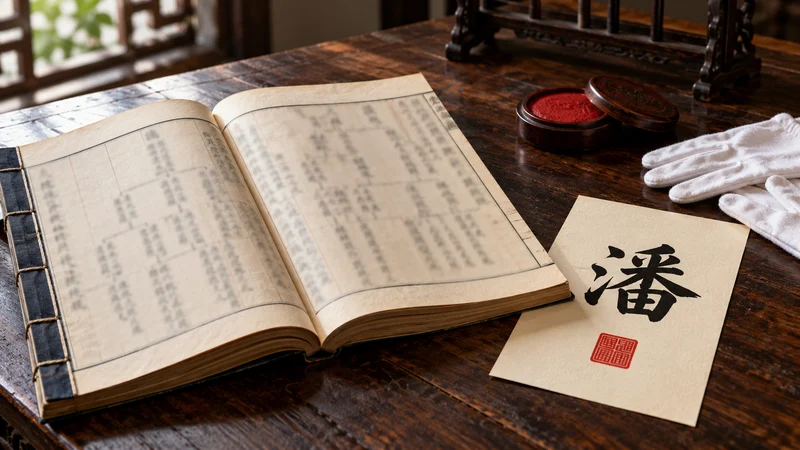
Quick facts about Pan and 潘
- Common character
- 潘
- Mandarin reading
- Pān
- Other possibilities
- 盤 and 泮 are separate surname characters also romanized Pan
- Origin boundary
- A surname tradition does not prove a modern family line
- Best first evidence
- A record preserving the Chinese character, place, date, and relative
- Common character: 潘
- Mandarin reading: Pān
- Other possibilities: 盤 and 泮 are separate surname characters also romanized Pan
- Origin boundary: a surname tradition does not prove a modern family line
- Best first evidence: a record preserving the character, place, date, and a relative
The Taiwan Ministry of Education dictionary identifies 潘 as a surname and records the reading ㄆㄢ, represented in Mandarin pinyin as Pān. That supports the pronunciation and surname use. It does not identify a particular family's origin.
What 潘 means and how it is pronounced
Dictionary history associates 潘 with rice-washing water and also records it as a surname. The lexical meaning is part of the character's language history, not a personality description. It does not mean a Pan family worked with rice, came from water, or shares a particular trait.
Pronunciation also needs a language label. Pān is the Mandarin reading. A family using Cantonese, Hakka, Hokkien, Teochew, or another variety may preserve a different pronunciation or romanization. Older English-language records may reflect the writer's hearing, a regional spelling convention, or an administrative choice. Save each spelling with its source, date, and place instead of replacing it with a modern form.
Traditional origin accounts associated with 潘
FamilySearch's Pan surname entry, drawing on the Dictionary of American Family Names, summarizes several traditional accounts for 潘. One links the surname to a place called Pan and a fief associated with Ji Sun, a son of the Duke of Bi. Another associates it with descendants of Pan Chong in the state of Chu. The same entry also records later adoption accounts, including one connected with a Xianbei family during the Northern Wei period.
These accounts should be presented as surname-history traditions. They show that reference works preserve more than one route by which the surname may have been used. They do not establish that every person writing 潘 descends from one ancient founder, and they cannot fill missing generations in a modern family tree.
If a clan genealogy names a founding ancestor, ancestral hall, migration route, or generation poem, transcribe those details before comparing them with other records. A famous Pan figure with the same character is not automatic evidence of descent.
Other Chinese surname characters can also be written Pan
FamilySearch separates 盤 and 泮 from 潘. Its Pan entry gives 盤 a traditional account associated with Pan Hu and describes 泮 as a distinct surname possibly connected with a place name. These are not alternative spellings of one identical family history. They are different characters that happen to share the Roman-letter form Pan in some records.
The same page also notes that Pan may represent additional regional romanizations or surnames in other languages. This is why a database query should combine the surname with a given name, location, date, occupation, and relative. When a catalog accepts Chinese text, search the verified character as well as the romanized form.
The Yuan surname guide shows the same research principle in another name: one Latin spelling may point to several characters. The Chinese family-name order guide helps distinguish a family name from a given name when reading forms and indexes.
Separate a surname tradition from a documented family line
A surname origin account answers, “What traditions are associated with this written surname?” Genealogy asks, “Which records connect this person to named parents, children, spouses, places, and dates?” The two questions overlap, but they are not interchangeable.
Write conclusions in layers. For example: “The 1940 document spells the name Pan”; “a later gravestone gives 潘”; “the Mandarin reading is Pān”; and “two records name the same spouse and village.” Each sentence has a different source and a different level of certainty.
Do not smooth over conflicts. Two birth dates, two village names, or two versions of a relationship may signal a clerical error, an alias, a translation issue, or two different people. Preserve both readings until another source resolves the difference.
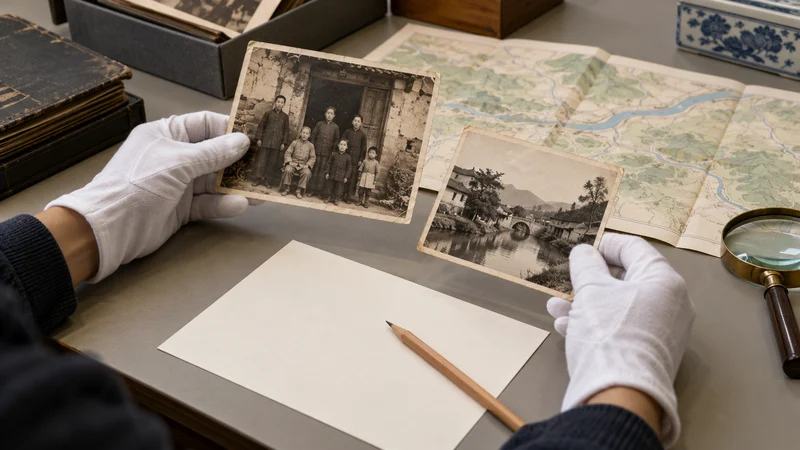
Quick reference: verify a Pan surname in five steps
- Copy the romanized surname exactly from each record.
- Find a Chinese-language source that preserves the character.
- Record the language, locality, date, and person attached to each spelling.
- Compare relationships and places before merging two identities.
- Keep a traditional origin account separate from the documented family tree.
This method may leave the character uncertain for a time. That is better than choosing 潘 without evidence. An unresolved alternative is an honest research result and a clear prompt for the next record search.
Build a Pan family record one generation at a time
Start with the most recent person whose identity is certain. For each generation, capture the name as written, Chinese characters if present, event date and place, named relationships, record type, and archive or collection. A simple table exposes missing links:
| Field | What to record | Why it matters |
|---|---|---|
| Name | Pan spelling plus original character | Separates 潘 from 盤, 泮, and other possibilities |
| Place | Village, county, port, or residence | Distinguishes people with similar names |
| Date | Birth, marriage, migration, death, or record date | Tests whether records can describe the same person |
| Relationship | Parent, spouse, child, sibling, or sponsor | Connects generations instead of relying on surname alone |
| Source | Archive, file, volume, image, or URL | Lets another researcher verify the claim |
For Chinese American research, the U.S. National Archives at Boston explains that Chinese Exclusion Act case files may include a person's name, birthplace, occupation, relatives, family history, photographs, and village maps. These files can connect people and places, but they were created within a discriminatory immigration system. Statements may contain aliases, administrative spellings, inconsistencies, or testimony shaped by the legal process. Compare them with family papers and other records rather than treating one file as infallible.
Questions about Pan surname origin
What Chinese character is most commonly associated with the surname Pan?
潘 is a common Chinese surname character romanized Pan. Because the same spelling can represent other characters, confirm it in a Chinese-language record tied to the family.
How is the surname 潘 pronounced in Mandarin?
It is pronounced Pān in Mandarin. Regional Chinese varieties may use different sounds and spellings, so label the language of each pronunciation.
What is the traditional origin of the surname 潘?
FamilySearch summarizes several traditions, including accounts associated with a place called Pan, Pan Chong in the state of Chu, and later surname adoption. These are surname-level histories, not proof of one continuous modern lineage.
Does Pan always mean the surname 潘?
No. 盤 and 泮 are among other Chinese surname characters that can be romanized Pan, and the same letters also occur in non-Chinese surnames. The original character and record context determine the relevant history.
How can I verify which Pan surname belongs to my family?
Find a record that preserves the Chinese character and ties it to a known person. Then compare names, locations, dates, and relationships across family papers, genealogies, civil records, gravestones, and relevant archives.
Pan surname origin becomes a precise question only after the character is known. Use dictionary and surname-history sources for language and context, then let dated records establish the family line one generation at a time.