 Chinese Surname Guide
Sun Surname Origin: 孙, 孫, and the Different Family Accounts
Quick Answer: The Chinese surname Sun commonly represents 孙, written 孫 in traditional characters and pronounced Sūn in Mandarin. Its everyday meaning is grandson, but the surname has more than one recorded origin account. Stories associated with Wey, Qi, and Chu should be treated as distinct surname traditions, not as proof that every Sun family shares one ancestor.
The character answers the meaning question first
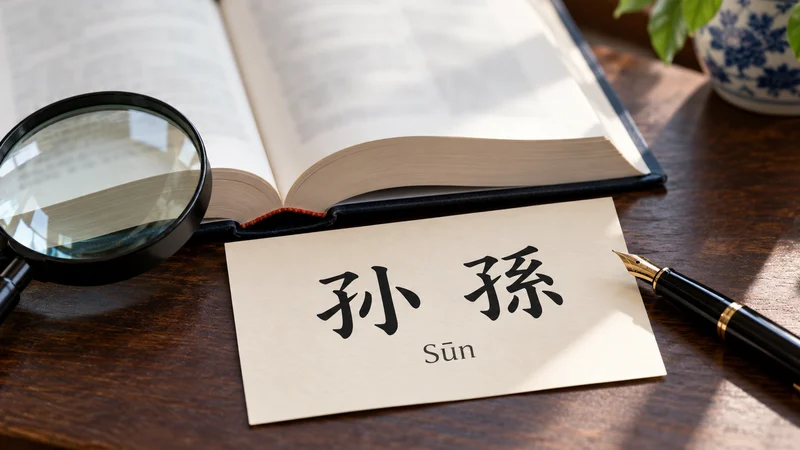
The simplified form 孙 and traditional form 孫 represent the same character here. Zdic's dictionary entry lists the surname sense under sūn, alongside kinship meanings such as grandson and descendants. Its separate xùn entry concerns another use of the character; that does not make Xùn the normal reading intended in this surname guide.
The pronunciation and meaning above come from the dictionary. The origin accounts below come from the surname-history entry published by FamilySearch. Keeping those sources separate matters: an English-language surname database is not automatically a source for tone marks.
Do not translate a person's family name as a description of that person's place in the family. Sun is a surname when used as a surname. A person carrying it is not necessarily someone's grandson in the document you are reading, and the character's kinship meaning does not establish a particular ancestor.
Quick Facts
- Simplified surname
- 孙
- Traditional surname
- 孫
- Mandarin reading
- Sūn, from the dictionary surname sense
- Reference meaning
- Grandson or descendants
- Origin traditions
- Separate Wey, Qi, and Chu accounts
Three origin accounts should remain three accounts
The Dictionary of American Family Names entry presented by FamilySearch records several Chinese Sun origins. Three involve earlier names or style names from different states:
Quick Reference
| Account in the surname entry | Connection described | How to use the account |
|---|---|---|
| Hui Sun and Wey | Descendants adopted Sun from Hui Sun's style name | A reported origin tradition, not a personal family identification |
| Sun Shu and Qi | An official received the surname in recognition of service | A separate account that should not be merged with the Wey story |
| Sun Shu Ao and Chu | Descendants took Sun from a style name | Another distinct account, not a universal starting ancestor |
Zdic also reproduces a historical surname note under the traditional 孫 entry that connects the name with Hui Sun of Wey. That is evidence that this account appears in surname literature. It is not a certificate connecting a present-day family to the person in that account.
These sources are reference works summarizing transmitted accounts. This page does not independently establish every event in those narratives. It also does not select one as the origin of an unknown reader's family. When a family genealogy names a branch, compare what it actually says rather than adding all three stories to one family tree.

The spelling Sun does not settle the language or character
The FamilySearch entry includes other uses of Sun in Chinese romanization and in Korean naming. A Latin-letter match is therefore not enough to establish either 孫 or a Chinese family origin. Ask what language the record uses and look for the original written name.
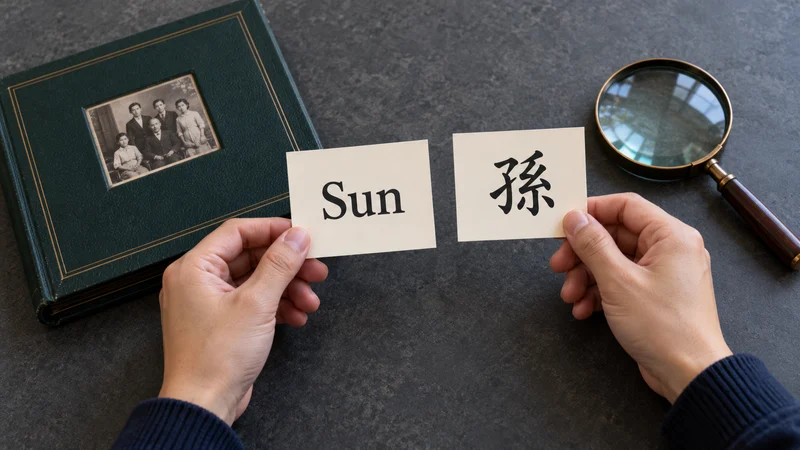
For a confirmed 孫 family, 孙 in a later document can be a script change rather than a surname change. By contrast, an entirely different character requires its own explanation. Copy the original form before normalizing it, and retain both the original transcription and the form used for searching.
This is especially useful when comparing records created in different places. A modern typed index may omit tone marks, simplify characters, or reorder names. Those changes can be convenient for searching without being enough to identify a person. FamilySearch's guide to Chinese names explains why the surname character is essential and why regional pronunciation can produce different spellings.
The distinction also prevents a common mistake with famous names. Finding the same surname in a historical biography supplies background, not a missing generation in a family tree. The next step is a record about the actual family, not a more impressive ancestral story.
Compare a family record before choosing an origin story
Consider a hypothetical pair of records. A family letter shows 孫 beside a village name, while a later certificate writes Sun in Latin letters. If dates and relatives also agree, the letter may help identify the written surname behind the certificate. It still does not prove which ancient origin account belongs to the family.
Now imagine a second person called Sun in the same city. A surname match and nearby address are reasons to investigate, not reasons to merge the records. Compare the full name, age, spouse or parent names, locality, and the date each document was made. Keep a disagreement visible rather than quietly changing a birth year to force a match.
If a relative has a genealogy, first record the book's title, branch, locality, and the people actually named. A general origin preface and a sequence of identifiable relatives do different jobs. The preface can repeat a traditional surname account while the later entries provide the family relationships that need comparison with other records.
For broader naming context, the site's family-name order guide explains surname and given-name placement. The Chinese surname versus given-name guide helps when a form or index separates the fields differently. Neither page can identify a family branch from Sun alone.
Quick reference for a Sun surname note
Quick Reference
| Field | What to keep |
|---|---|
| Original written surname | 孙 or 孫 exactly as shown, or another character if the record differs |
| Reading | Sūn for the Mandarin surname 孙/孫, with the dictionary source |
| Origin account | The specific Wey, Qi, Chu, or other account actually cited |
| Family connection | Which named people and records connect the generations |
| Uncertainty | Missing characters, conflicting dates, or a branch not yet identified |
An accurate short note might read: "Sun; character 孫 confirmed in a family letter; Mandarin Sūn; ancient branch not established." That is a useful result. It preserves the answer already supported without turning an unresolved family history into a confident claim.
Questions about the Sun surname
Does the surname Sun mean the English word for the star?
Not when it represents 孙/孫. In this Chinese surname, the dictionary meaning is connected with grandson or descendants; the similar English spelling does not supply the Chinese meaning.
Are 孙 and 孫 different surnames?
They are simplified and traditional forms of the same character in this context. Preserve the form shown in a record, but do not treat the script difference alone as a different family name.
Which ancient Sun ancestor belongs to my family?
This cannot be decided from Sun or 孫 alone. Reference works record several origin accounts; a family-specific claim requires linked records rather than a shared surname.
Why is the Mandarin surname written Sūn rather than Xùn here?
Zdic lists the surname sense under sūn. Its xùn entry refers to a different usage of the written character, not the normal surname reading used on this page.