 Chinese Surname Guide
Zheng Surname Origin: Zheng State, 郑 and 鄭, and Records
The origin question has a concrete starting point: which character does your family use? For the surname written 鄭, or 郑 in simplified Chinese, the historical place-name connection comes before any attempt to build a personal family tree.
Quick Answer: The surname Zheng written 鄭 (simplified 郑; Mandarin Zhèng) is traditionally associated with the former state of Zheng. A historical account of that state and a dictionary's surname-origin tradition provide context, not proof that every modern Zheng family descends from one named ancestor. Confirm the original character before applying this account to a family.
Character and source anchors for Zheng
- Traditional surname character
- 鄭
- Simplified surname character
- 郑
- Mandarin pronunciation
- Zhèng: fourth tone, as given by the dictionary
- Surname origin account
- The former state of Zheng
- Historical source
- Shiji, chapter 42, Zheng hereditary house
- Personal-lineage limit
- A shared surname is not a documented chain of descent
The dictionary supplies the modern pronunciation and written-form information. The historical text records an account of the state; neither is a substitute for a family's own records.
Start with 郑 or 鄭, not with an English spelling
Hanzi dictionary Zdic identifies 郑 as the simplified form of 鄭 and gives the Mandarin reading zhèng. The accent is the fourth-tone mark. These two written forms are not, on that basis alone, two separate family lines.
An English spelling does not preserve the original character on its own. If the only information you have is Zheng on a modern form, ask for a Chinese-language family or official record before selecting an origin account. A surname is not safely reconstructed by choosing the first character a search engine returns.
For a practical distinction, compare the actual characters here: 郑 = simplified; 鄭 = traditional. When transcribing a record, keep the form actually written and add a modern search equivalent in a separate note. That preserves the original evidence without making it harder to search.
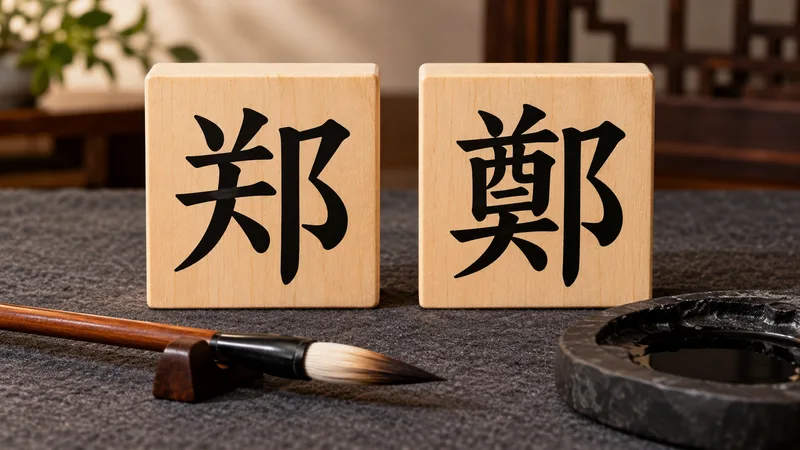
The Zheng state account and the later surname tradition
Chapter 42 of the Shiji, the hereditary house of Zheng, begins with Duke Huan of Zheng, named You. Its opening identifies him in relation to the Zhou royal family and describes his enfeoffment at Zheng. This is the historical narrative behind the state-name discussion, not a statement about a modern reader's grandparents.
The dictionary's Kangxi section separately records the surname tradition: after Zheng was overcome by Han, descendants took the state's name as their surname. That is the source for the traditional state-to-surname explanation. It is more precise to attribute the account than to turn it into an unconditional claim that all people called Zheng have one proven founder.
These sources answer different questions. The Shiji supplies a narrative about the state and its rulers. The dictionary preserves a surname-origin explanation. A family genealogy would need to establish the much later links between named people in a particular branch. Do not silently treat those three types of evidence as interchangeable.
A place-name origin is not a literal character translation
Here the useful historical explanation is a connection with a named state. It is not a personality definition. Translating the surname as a promise that someone is upright, solemn, noble, or destined for success confuses other uses or associations of a character with the evidence for a family name.
Likewise, an old place name and a family's recent hometown answer different questions. A modern address in a family record cannot by itself identify where a surname first arose. Conversely, the ancient origin account cannot tell you where a particular great-grandparent lived. The direction of reasoning matters: start with the person and record, not with a distant place that happens to fit the story.
A short introduction can therefore say, 'Our surname is written 鄭; the usual origin account connects it with the state of Zheng.' A stronger statement such as 'Our branch descends from this named ruler' needs additional evidence. It should not be added simply because it makes an interesting opening to a family history.
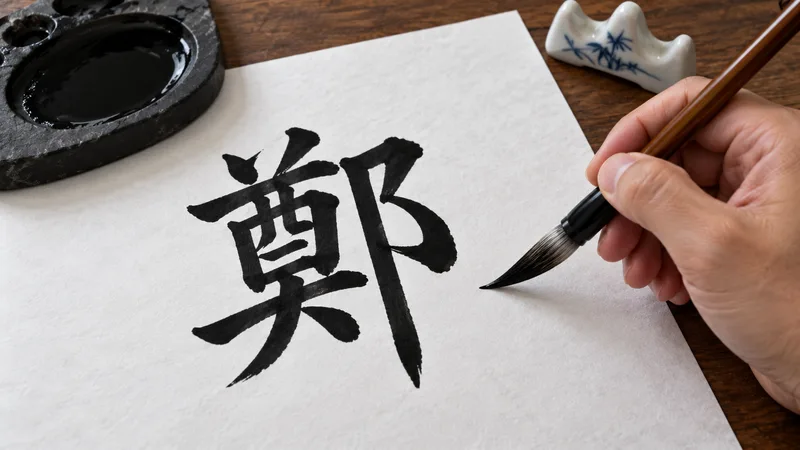
One family-record example, with the unknowns left visible
Suppose a reader has an English-language certificate naming a relative as Zheng and a family letter bearing 鄭. The character agreement is useful, but it does not prove that two similarly named people in a search result are the same person. First match the given name, approximate dates, places and named relatives. Where they disagree, retain the disagreement rather than smoothing it out.
A sensible working note separates the observations: 'Certificate: Zheng; family letter: 鄭; relationship between the two document subjects not yet confirmed.' The dictionary helps read the character, while the origin account supplies cultural background. Neither closes the missing relationship between the documents.
When a full name appears, also separate surname from given name. The surname and given-name guide explains those fields. If a form uses a different name order, the family-name order guide provides a brief introduction; it is not a substitute for the record holder's stated name.

Quick Reference: what each piece of evidence answers
| Evidence | Reasonable conclusion | What it does not establish |
|---|---|---|
| 郑 / 鄭 in a dictionary | Written forms and Mandarin reading | A particular person's ancestry |
| Shiji, chapter 42 | An account of the state and its rulers | A complete modern family tree |
| Surname-origin tradition in the dictionary | A traditional explanation involving the state name | One proven origin for every romanized Zheng |
| A dated family record with named relatives | A possible link to investigate for that branch | Every missing generation |
Keep a source's actual task separate from what you hope it will prove.
Questions about the Zheng origin account
Are 郑 and 鄭 different surnames?
They are simplified and traditional written forms of the surname discussed here. The written-form difference alone does not demonstrate different ancestry.
How is 郑 pronounced in Mandarin?
The dictionary gives Zhèng, with a fourth tone. This pronunciation comes from the dictionary, not from a family-tree search result.
What connects the surname with the state of Zheng?
A dictionary records the traditional account that descendants adopted the state's name after its defeat. The Shiji separately narrates the state's history. Neither proves a modern family's complete line of descent.
Can the spelling Zheng establish my Chinese surname character?
No. Confirm the character from a family or official record rather than relying on the English spelling alone.
Does the ancient state name identify my family's recent hometown?
No. The surname-origin account and a documented hometown concern different questions. Use records for the particular person or family branch.
Dictionary and historical text
- Zdic: 郑 / 鄭, modern reading and the cited surname tradition
- Shiji, chapter 42: Zheng hereditary house (Chinese primary text)
Sources checked November 2, 2026. The historical account and the traditional origin explanation are attributed to their sources, not certified as a modern reader's genealogy.