 Chinese Surname Guide
Zhu Surname Origin: Character, History, and Records
Zhu is usually associated with the character 朱 in Mandarin, but a romanized spelling cannot identify every person's character or family line by itself. A careful answer separates the character's dictionary meaning, recorded surname traditions, and evidence for one family.
Quick Answer: The Zhu surname is commonly written 朱 and pronounced Zhū in Mandarin. The character has a dictionary meaning connected with vermilion or cinnabar, while surname references also record traditions linking some Zhu lines to the ancient state of Zhu. Other Chinese surname characters can also be romanized Zhu, so confirm the written character and family records before drawing an ancestry conclusion.
Quick facts about the Zhu surname
- Common character
- 朱
- Mandarin pinyin
- Zhū
- Character meaning
- Vermilion or cinnabar in dictionary use
- Recorded origin tradition
- Some surname accounts connect 朱 with the ancient state of Zhu
- Verification boundary
- A romanized spelling does not prove one character or lineage
These facts describe a surname category. They do not establish a person's ancestry, clan, ethnicity, or relationship to a historical figure.
Begin with the Chinese character, not the Latin spelling
For many Mandarin speakers, Zhu refers to 朱, written with the pinyin Zhū. The Chinese Text Project dictionary lists the pronunciation and includes surname use. The character's ordinary dictionary senses include vermilion and cinnabar.
That character meaning is not a personality profile or a family history. It explains the written form, not why a particular person bears the surname. Treat phrases such as red, vermilion, or cinnabar as lexical context only.
Romanization can also hide distinctions. The FamilySearch Chinese surname finder maps 朱 to spellings including Zhu, Ju, Jhu, and Chu. Conversely, the spelling Zhu can represent other Chinese characters in different records. The original character is therefore the first piece of evidence to collect.

The state-of-Zhu account is a surname tradition, not a personal pedigree
A common surname-history account connects 朱 to the ancient state written 邾. The FamilySearch Zhu surname entry summarizes a tradition in which descendants simplified the state name to 朱 after the state was annexed. This is useful historical context for the surname category.
The same reference also records more than one origin tradition and more than one character romanized Zhu. That matters because an origin list is not a single family tree. A person cannot move directly from the spelling Zhu to one ancient ancestor without records linking each generation.
Use the state tradition as a question to investigate: does a family genealogy name the same character, place, branch, or migration path? If not, leave the connection unproven rather than filling the gap with a famous narrative.
Other Zhu characters require separate treatment
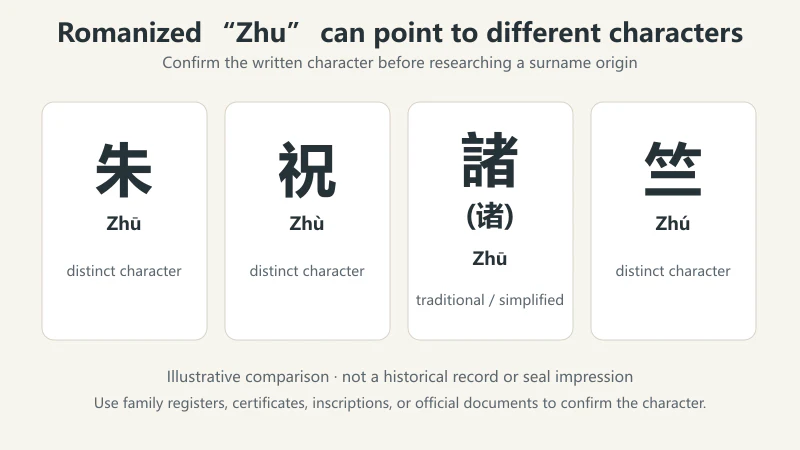
Surname references also associate the romanization Zhu with characters such as 祝, 諸 or 诸, and 竺. Their meanings, pronunciation histories, and origin traditions are not interchangeable with 朱. A database search should therefore include the exact character found in the family's documents.
Regional and historical spellings add another layer. Ju, Jhu, Chu, Choo, or another form may reflect a romanization system, dialect, migration record, or clerk's spelling. Similar spelling is a clue for comparison, not proof that two families share the same Chinese character.
Preserve every form exactly as it appears before normalizing anything. Record the source, date, place, language, and person named. A later research note can connect variants while the original transcription remains available for review.
Build a record chain from known relatives backward
Start with a known person and collect records that identify a relationship: birth and marriage records, household documents, immigration files, obituaries, gravestones, school records, family letters, and genealogies. One document may supply a character while another supplies a parent, residence, or earlier spelling.
For each item, note who created it, when, where, and how close the creator was to the event. A later copied genealogy can preserve valuable clues, but a contemporary record tied to the named person may answer a different question more directly.
Do not merge people because they share Zhu, 朱, a hometown, or a generation name. Compare dates, places, relatives, occupations, and migration details. When evidence conflicts, preserve both readings and mark the unresolved point.
State the conclusion at the level the evidence supports
A strong conclusion might say that a record confirms 朱 for a named relative, or that two documents connect a parent and child. A weaker but still useful conclusion may say that a spelling is a candidate requiring the original Chinese record.
Avoid claims such as all Zhu families descend from one state, all Chus use 朱, or a character meaning predicts family traits. These claims exceed what character dictionaries and surname overviews establish.
For related context, review Chinese family-name order, compare the role of given names in Chinese surname vs given name, and see another character-first example in the Lin surname guide.

Zhu surname evidence table
| Evidence | What it can support | What it cannot prove alone |
|---|---|---|
| A record showing 朱 | The written surname for the named person | An ancient origin or complete lineage |
| A surname-history overview | Documented traditions for a surname category | That one family follows every tradition |
| A romanized form such as Zhu or Chu | A search spelling to compare | One unique Chinese character |
| A chain of linked family records | Relationships across the documented generations | Unrecorded generations beyond the chain |
Keep scans or citations for every link in the chain, and label an inference as an inference.
Questions about the Zhu surname
What is the most common Chinese character for Zhu?
朱 is a common character for the Mandarin surname Zhu, pronounced Zhū. Other surname characters can also appear as Zhu, so check an original record.
What does the character 朱 mean?
Dictionary senses include vermilion or cinnabar. That lexical meaning does not describe a bearer's personality, ancestry, or family status.
Does every Zhu family come from the ancient state of Zhu?
No. The state account is one recorded surname tradition, not proof for every family. A personal claim needs a documented family chain.
Can Chu, Ju, or Jhu be the same surname as Zhu?
They can be romanization variants for 朱 in some records, but similar spellings can also represent other characters. Confirm the Chinese character and record context.
How do I research my Zhu family line?
Begin with known relatives, preserve the exact character and spelling in each source, and connect generations with records that identify dates, places, and relationships.
Surname sources and related guides
- Chinese Text Project dictionary: 朱
- FamilySearch: Zhu surname entry
- FamilySearch: Chinese surname finder
The dictionary supports character and pronunciation facts. The surname resources summarize category-level spellings and traditions; they do not prove an individual lineage.